Before you buy
Reading a Dash Cam Spec Sheet: Which Numbers Actually Matter?
On a dash cam spec sheet, read four lines: the sensor behind a 2K label, the horizontal field of view, the shipped frame rate and the card's speed class.
Most dash cam spec sheets are honest about the easy numbers and quiet about the ones that decide whether the footage is usable. Four lines carry almost all the risk: the resolution label (is it native or interpolated?), the field of view (diagonal, or horizontal?), the frame rate (what does the camera ship set to?), and parking mode (does it need constant power, and is there a voltage cutoff?). Read those four with their conditions attached and the rest of the sheet mostly falls into place.
Which dash cam spec actually decides image quality?
The sensor and the lens, not the resolution label. A recording resolution is only the size of the file the camera writes; the sensor’s optical format and the lens aperture decide how much light reaches it, which is what separates readable footage at dusk from noise. So ask for three things in writing: the sensor model, the optical format and the aperture.
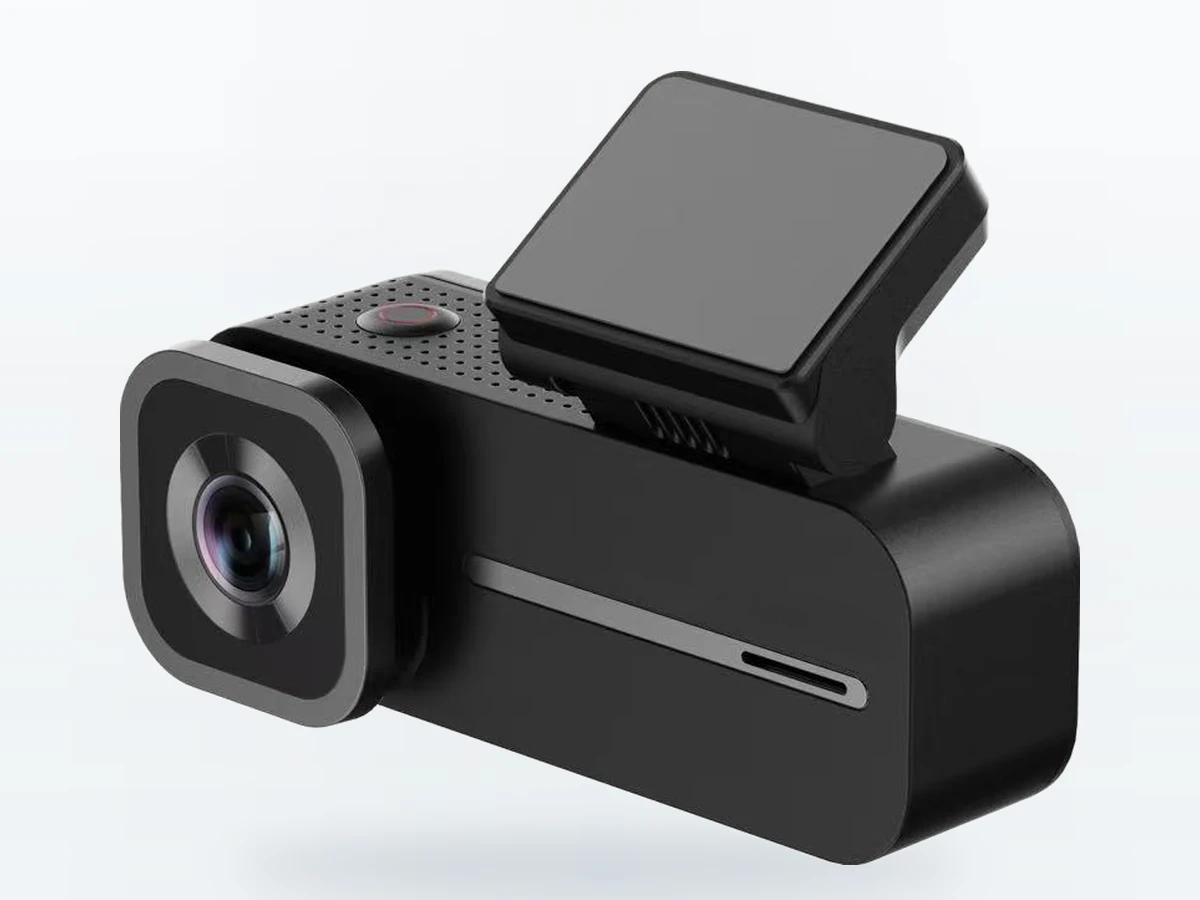
The H2 uses a 2 MP CMOS OS02H10 sensor in a 1/2.8-inch optical format, and the same sensor in all three cameras. The road lens is F1.55, 3 mm, 2G4P; the cabin lens is F2.0, 3 mm, 2G3P1R. The road camera also runs hardware HDR, WDR and 3D DNR — processing that applies to that lens only, not to the cabin or rear view.
| Camera | Sensor | Recording resolution | Lens | Field of view (diagonal / horizontal / vertical) | In the standard box? |
|---|---|---|---|---|---|
| Road (forward) | 2 MP CMOS OS02H10, 1/2.8-inch | 2560×1440, interpolated from a native 1920×1080 sensor | F1.55, 3 mm, 2G4P | 136.8° / 115.8° / 61.4° | Yes |
| Cabin (interior) | 2 MP CMOS OS02H10, 1/2.8-inch | 1920×1080 | F2.0, 3 mm, 2G3P1R | 138° / 115.8° / 62° | Yes |
| Rear | 2 MP CMOS OS02H10, 1/2.8-inch | 1920×1080 | F2.0, 2G3P | 132° / 107° / 55° | No — comes with the rear-camera kit option, +$20 |
What does "2K" on a dash cam spec sheet really mean?
It means the file is 2560×1440 pixels. It does not tell you the sensor captured 2560×1440 — on many cameras, the H2 included, that mode is interpolated, scaled up from a smaller native capture. The H2’s road camera records 2K 2560×1440 interpolated from a native 1920×1080 sensor. That is the whole truth of the line, and it is the sentence you should be able to find on any spec sheet that prints a resolution larger than its sensor.
How to check it yourself: look for the sensor’s native resolution stated separately from the recording resolution. If a sheet gives a recording mode but never names the sensor or its native output, the interpolation question is unanswered, not answered in your favour. And if native 4K is your actual requirement, the H2 is the wrong camera — its cabin and rear cameras are 1080p and the road camera’s sensor is 1080p underneath.
Is a wider field of view better?
Not automatically, and the number quoted is usually the most generous of the three. Field of view has a diagonal, a horizontal and a vertical figure, and the diagonal is always the largest — so a camera advertised at "138°" may see less across the road than one advertised at 120° horizontal. A very wide lens also spreads the same pixel count over more scene, which pushes detail at the edges further away.
Ask for all three figures. The H2’s road camera is 136.8° diagonal, 115.8° horizontal and 61.4° vertical; the cabin camera is 138° / 115.8° / 62°, and the rear camera in the kit option is 132° / 107° / 55°. Those horizontal numbers are the ones to compare between cameras, because they describe how much of the road’s width is in frame.
What does the frame rate number leave out?
What the camera is actually set to when you take it out of the box, and whether the top rate holds in every mode. A sheet saying "30 fps" is a ceiling, not a setting. The H2 records up to 30 fps with a 25 / 30 / Auto menu, and it ships on 25 — so the number on the sheet and the number in your first week of footage are not the same until you change it.
Which storage numbers on the sheet matter?
The sustained write-speed class, not the maximum capacity. "Supports up to 256 GB" says nothing about whether a card can keep up with continuous video; U3 or V30 is the line that does, because both mark a guaranteed 30 MB/s sustained write. Capacity only decides how far back the loop reaches before it overwrites.
The H2 supports 32–256 GB cards at U3/V30 or above, and a 64 GB card is included and pre-installed. Loop recording runs in 1-, 2- or 3-minute segments with event clips locked out of the loop. How long 64 GB holds depends on how many cameras are recording, the frame rate and whether parking mode is adding clips — which is why no honest sheet prints an hours figure, and ours does not either. Our guide to dash cam microSD cards walks through that trade-off.
What should a spec sheet say about parking mode?
Three things: where the power comes from, what stops it before your battery is flat, and how long a watch can run. A camera that lists "parking mode" with none of those has described a menu item, not a capability. Constant power is the requirement — a cigarette-lighter socket that dies with the ignition cannot run it.
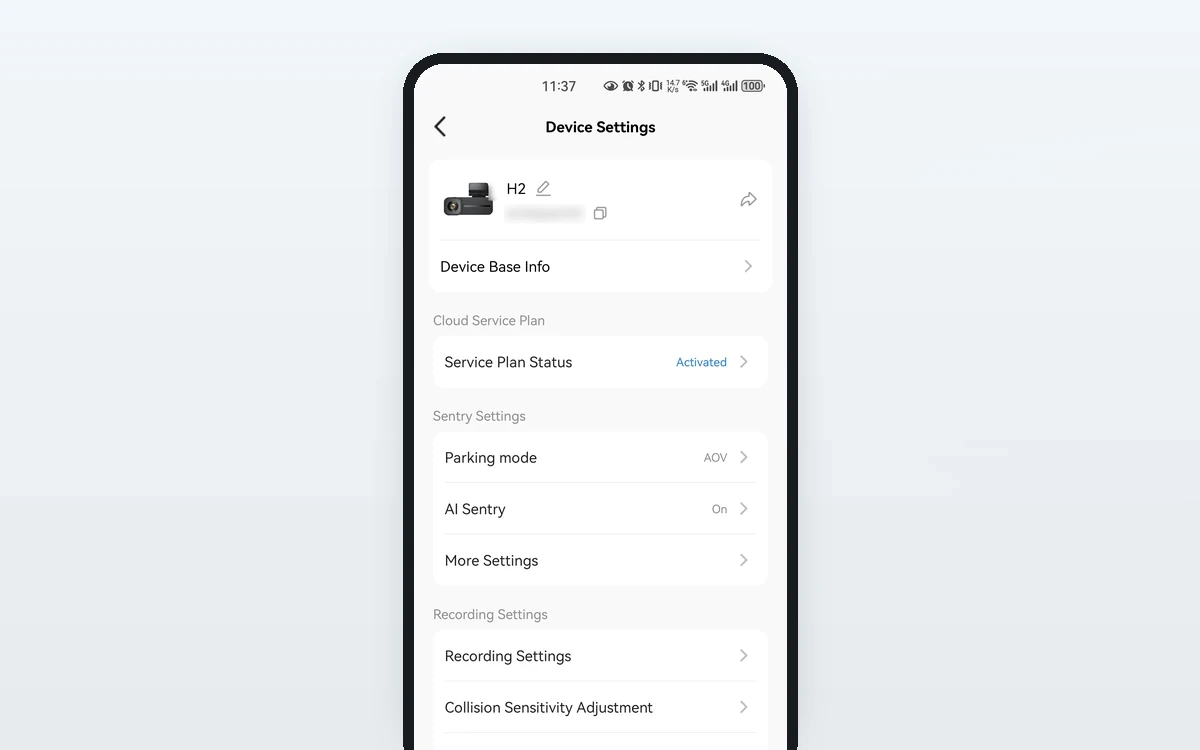
On the H2: AI Sentinel parking monitoring runs in windows of up to 24 hours, with collision detection and low-voltage protection that ends monitoring when the car battery falls to a set threshold. Power comes from the included B+/ACC/GND hardwire cable and fuse-box adapter set, or from the OBD-II power adapter included free with the current batch while supplies last. There is no car-charger cable in the box, and no internal battery — the camera runs on vehicle power at 12–24 V.
Which lines does a connected camera tend to leave off?
The plan requirement and the quality of the remote copy. On any camera with live view or cloud clips, recording to the card is one thing and getting video to your phone is another: the second needs data, and usually a subscription. The H2’s cellular is built in with no SIM card to buy, but remote live view, push alerts, cloud event storage and live GPS all need an active plan plus coverage — plans run $9.99, $19.99 and $29.99 per month, with Standard Yearly at $199.99. Local recording needs no plan at all.
The other missing line is the remote stream’s resolution. The H2’s cloud copy is 1280×720 at 30 fps — smaller than the file kept on the card. That is normal for cellular upload and it matters for expectations: the clip you watch in the app is not the evidence-grade original, which is still on the microSD card.
What a spec sheet cannot tell you
Some of the numbers buyers most want do not exist in a form anyone can honestly publish. There is no supportable night-vision range figure for a dash cam and no "plates always readable" claim: the H2’s cabin optics pass 940 nm infrared and its road camera has hardware HDR, but distance and legibility depend on your lighting, speed, angle and the plate itself, so we publish no figure. The same goes for parked hours and recording hours — both depend on your car’s battery, the temperature and your settings.
Two more limits worth naming. A spec sheet cannot show you footage; reviews with real clips from the camera you are considering tell you things no sensor model will. And it cannot tell you whether the install suits your car — fuse positions and OBD-II port locations differ by vehicle, and that is a question for your install or an installer, not the sheet. If the sheet is the only evidence a seller offers, treat the unstated lines as unknown rather than acceptable.
The short version
- Sensor and aperture decide image quality, not the resolution label. Get the sensor model and optical format in writing.
- A resolution larger than the sensor is interpolated. The H2 records 2560×1440 interpolated from a native 1920×1080 sensor; if you need native 4K, buy something else.
- Compare horizontal field of view, because the advertised diagonal is always the biggest of the three numbers.
- Frame rate on a sheet is a ceiling. The H2 does up to 30 fps and ships set to 25.
- For cards, read the speed class — U3/V30 or better — before the capacity. The H2 takes 32–256 GB and includes a 64 GB card, pre-installed.
- Parking mode is only real with constant power, a voltage cutoff and a stated window. The H2: up to 24 hours, low-voltage protection, hardwire cable and fuse taps in the box.
- Connected features cost data. Local recording on the H2 needs no plan; live view, alerts and cloud clips do, and the cloud copy is 1280×720 at 30 fps.
Full published figures are on the H2 spec page and in the FAQ.